


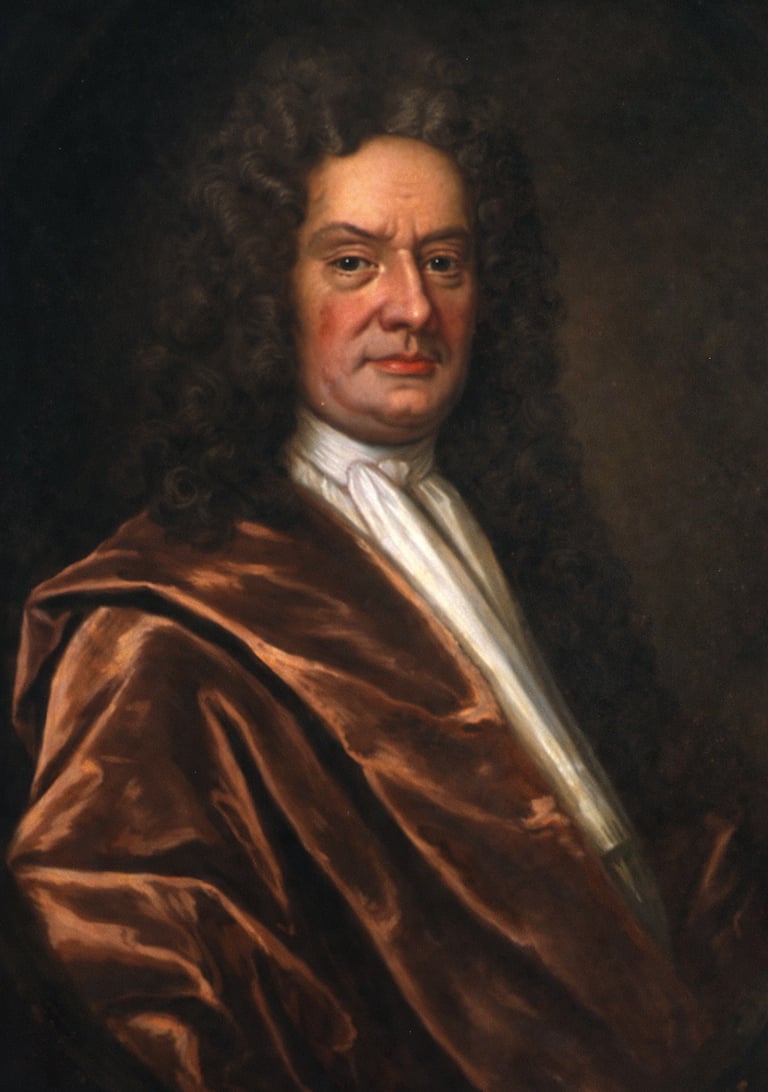
Andreas Gottlieb, Baron von Bernstorff
( 20 February 1649 | † 16 July 1726)*
Andreas Gottlieb Graf von Bernstorff (1649–1726) was one of the most distinguished German statesmen of early modern Europe — a member of the noble Mecklenburg family of Bernstorff, and a central figure in the consolidation of a political and administrative ethic that came to define his age.
Born at Ratzeburg, upon a continent marked by confessional conflict and dynastic rivalry, Bernstorff was formed under a worldview that conceived of power not as absolute dominion, but as a trust held in keeping. His humanist education and his sound legal training instilled in him the conviction that to govern, to administer, and to decide are acts of vocation — demanding discipline, prudence, and accountability before time and before history.
Throughout his career, Bernstorff distinguished himself as a diplomat and strategist in the service of the princely houses of northern Germany, culminating in his tenure as Prime Minister of the Electorate of Hanover. In that capacity, he was among the principal architects of the Hanoverian succession to the British throne in 1714, contributing decisively to the consolidation of a constitutional order grounded in the primacy of law, the limitation of power, and institutional stability.
His work in London, at the head of the German Chancery, reflected with clarity the principles of responsible stewardship: to govern with sobriety, to eschew excess, to preserve the balance among nations, and to ensure that political decisions served continuity rather than immediate expediency. For Bernstorff, power found its legitimacy solely when exercised with ethical responsibility and the long view.
Following the union of the Duchy of Brunswick-Lüneburg with the Electorate of Hanover in 1705, Bernstorff entered Hanoverian service. As Prime Minister of Hanover, he was instrumental in the accession of George I to the British throne in 1714, avoiding entanglement in domestic English disputes and supporting the Holy Roman Empire and the Netherlands against France.
Upon the accession of George I, Bernstorff accompanied the new sovereign to England, where he continued to play a significant role in political affairs, leading the German Chancery and exerting considerable influence upon English policy.
Raised to the nobility of the Holy Roman Empire, Bernstorff also gave material form to his legacy through the acquisition and development of estates such as Gartow and Wotersen, where he caused new castles to be built — conceived not merely as patrimonial symbols, but as expressions of permanence, order, and responsible administration: the foundations of a legacy intended to endure across the generations.
The legacy of Andreas Gottlieb Graf von Bernstorff resides not in accumulation, but in the manner in which he administered that which was entrusted to him. His life represents the synthesis of reason, governance, and historical responsibility — values that continue to inspire the contemporary practice of Graf Von Bernstorff Imperial Capital.
GRAF VON BERNSTORFF
Contato
A Family Office founded by Marcelo Bernstorff Junior, inspired by the European tradition of patrimonial stewardship, wherein capital is regarded as a matter of historical responsibility and an entrusted legacy. We operate with rigorous governance, discipline, and the long view, to preserve and to expand patrimony across the generations.
© 2026 Graf Von Bernstorff Imperial Capital. All rights reserved.


IMPERIAL CAPITAL
Capital in Stewardship. A Legacy for Generations.
Family Office and Strategic Investment
info@gvbic.com